
SEPPES supplies automatic sliding glass doors for commercial entrances, with complete door systems as its primary offer. Complete sliding-door operator systems can also be supplied separately without door leaves. Product configuration, included equipment and project interfaces are reviewed against the entrance requirements. Support includes remote online installation guidance and troubleshooting for the confirmed supplied scope.
For a distributor, installer or project buyer, the useful starting point is to identify what your team needs to purchase and what it will provide locally. A complete entrance order, an operator assembly for locally fabricated doors and a replacement-part request need different information. This guide explains those purchasing routes and the coordination involved.
SEPPES is the brand of Seppes Door Industry (Suzhou) Co., Ltd., a source manufacturer and OEM/ODM solution provider. For company background, manufacturing and quality-control information, visit About SEPPES. The sections below focus on its sliding glass door offer.
Automatic Sliding Glass Door Options from SEPPES
An entrance configuration combines several decisions: how the leaves move, how the glazed door is constructed and where the operating system is mounted. These are different dimensions of the design. An aluminum-framed entrance, for example, may use a bi-parting opening arrangement; a proposed combination still needs technical review.
Opening arrangement
The automatic sliding glass door product page is the starting point for the glazed entrance and its coordinated operating system. For a center-opening arrangement, review bi-parting sliding doors. Where side space is constrained relative to the required clear opening, a telescopic sliding-door arrangement may be worth evaluating.
Selection depends on the actual opening, the space available for moving leaves and fixed panels, and the passage required by users. A wider-looking doorway in a photograph does not establish the usable clear opening of your proposed entrance.
Door construction and installation conditions
All-glass sliding doors address a transparent, minimal-frame appearance. Aluminum-framed sliding doors provide a framed construction direction. Confirm glass, profiles, hardware, finish and moving weight together rather than selecting each item independently.
For projects considering a visible wall-mounted installation, review the surface-mounted sliding door. Existing walls, structural support, headroom and cable routes need assessment. Choosing a mounting approach does not by itself confirm that an existing entrance can be reused without alteration.
Complete Doors, Operator Systems and Individual Parts
Ask for an itemized proposal that identifies the supplied assembly, door construction, optional equipment and work by others. The three supply scopes below have different purchasing conditions.
| Purchase | Supply position | Confirm before ordering |
|---|---|---|
| Complete automatic sliding glass door | The primary offer: a project-configured entrance with an agreed door and operating-system scope. | Door leaves, glass, profiles, operator, sensors, controls, fixed panels and interfaces as applicable; identify every inclusion and exclusion. |
| Complete sliding-door operator system | Available separately without door leaves. This complete assembly is not restricted to existing customers or large-volume orders. | Compatible door construction and weight, opening layout, mounting, controls and the exact assembly contents; identify locally supplied items. |
| Individual components and accessories | Generally for existing customers’ replacement, spare-part and repair needs. Sufficiently large standalone component orders can be reviewed separately. | Item, quantity, compatibility and previous order or equipment details where applicable. Availability and any commercial conditions require confirmation. |
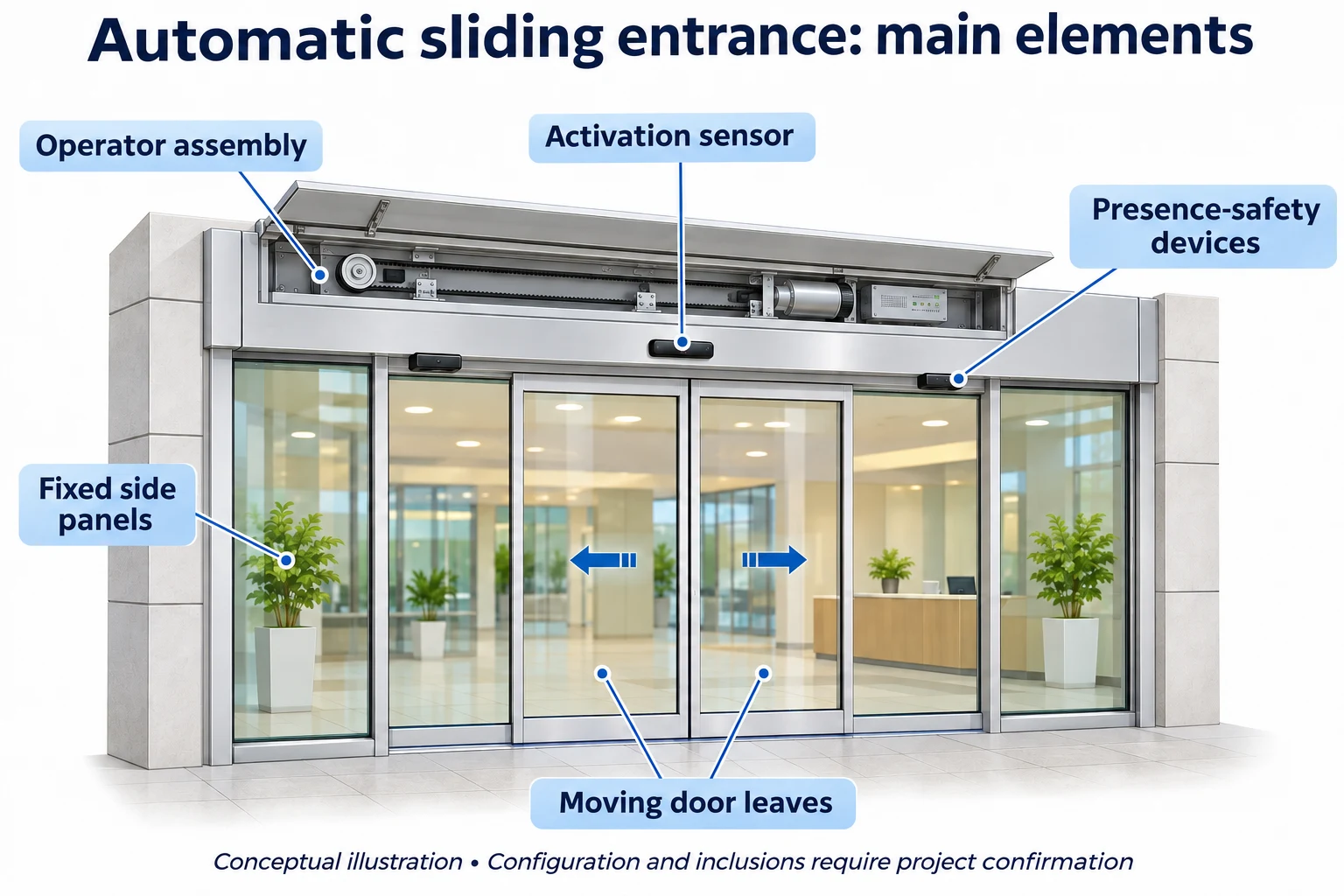
“Without door leaves” does not mean that every other entrance item is automatically included. Activation sensors, presence-safety devices, access readers, locking equipment and frames must be identified in the quotation. Likewise, a complete door order still needs a clear boundary for site preparation, power, installation and commissioning.
If your team plans to fabricate the door construction locally, the complete sliding-door opener system page explains the assembly review in more detail. Confirm the proposed combination before purchasing the operator and locally sourced construction as separate packages.
Project Configuration and OEM/ODM Coordination
Project coordination connects the architectural requirement with the supplied equipment. Useful starting inputs include opening dimensions, preferred leaf movement, glass and frame direction, traffic needs and mounting conditions. Sensors, controller functions, access control and locking interfaces should be discussed alongside those choices.
For an entrance connected to another system, identify the existing equipment and the required operating behavior. Explain who will check the interface, supply any additional equipment and complete the connection. A request for “access control” alone leaves important responsibilities unresolved.
OEM/ODM discussions can cover product or system configuration, project-specific door structures, private-label coordination, packaging, labels and available documentation. These are areas for agreement, subject to technical review, production feasibility and commercial confirmation. A branding request does not establish a new tested specification or guarantee that every requested modification is available.
Keep an agreed record of the selected configuration and any changes made during review. If the opening, glass construction or locally sourced equipment changes, bring that information back into the discussion before manufacturing. The sliding-door customization guide covers how related choices affect approval. For samples and repeat sourcing, read the OEM/ODM manufacturer selection guide. For channel terms and local service planning, use the distributor sourcing guide. For a telescopic entrance, the telescopic door brand comparison explains how to compare layouts and supply packages.
Support Before and After Shipment
Before manufacturing and delivery
SEPPES reviews the available project information to identify missing inputs and discuss the proposed door and system configuration. The next step is to agree the supply scope, quotation and relevant drawings or interface information. The documents available for a particular order should be confirmed rather than assumed from a general product description.
Production, inspection, packaging and shipment preparation follow the agreed order requirements. Discuss the delivery destination, requested project schedule and packaging needs during quotation. Confirm the applicable delivery terms and responsibilities in the commercial proposal; a requested site date is not a confirmed production or transport commitment.
At the installation stage
Remote online installation guidance can help the local team understand the supplied information and review questions concerning the agreed package. The buyer should identify who is responsible for site measurement, structural preparation, electrical work, installation and commissioning. Those responsibilities need to be practical for the project location.
Share site photographs and the relevant drawing or equipment reference when asking a technical question. A clear view of the installation condition is more useful than a general description such as “the door does not fit.” For preparation topics, use the installation planning guide.
After installation
Remote troubleshooting starts with identifying the supplied system and understanding the reported behavior. Previous order information, component labels, photographs, a short video and controller status can help the support team review an issue. Follow the applicable instructions for the actual equipment and have work performed by the responsible qualified local team.
Spare-part requests follow the supply policy above and require compatibility review. Record the relevant order and configuration so replacement discussions refer to the equipment actually installed. Confirm warranty terms and support arrangements for the order; this guide does not establish a universal warranty period, response time or on-site maintenance service.
Explore Relevant Entrance Applications and Projects
Existing SEPPES case pages provide examples of how entrance requirements and supplied configurations have been described. Use them to frame a project discussion while keeping their particular supply details separate from a new quotation.
- Convenience store entrance: a reference for customer traffic, shopping bags, small carts and visibility within a limited storefront width.
- Small hotel entrance: an example centered on daily guest arrivals and luggage movement in a compact lobby.
- Office building entrance: a reference for concentrated employee and visitor traffic, entrance construction and access coordination.
A similar building use does not establish identical opening dimensions, door loads or control requirements. Compare the entrance condition and responsibilities, then refer to the relevant commercial entrance solution for broader planning questions.
What to Send for a SEPPES Project Review
A useful first inquiry can contain confirmed information and clearly identified open questions. You do not need to invent a final specification to start a discussion. State what is known and which decisions your team needs help reviewing.
- Project context: country, delivery destination, building use, entrance location, quantity and requested schedule.
- Opening information: width, height, required clear passage, side space, headroom and available structural support.
- Door direction: opening arrangement, glass and frame preferences, finish and any known door-leaf construction or weight information.
- Operating requirements: expected traffic, activation, presence safety, access and locking needs, plus existing equipment details where relevant.
- Purchase boundary: complete door or complete operator assembly, items sourced locally and any separately requested parts.
- Site team and evidence: installation and commissioning arrangements, drawings, photographs and the person coordinating technical questions.
For a replacement request, include the earlier order reference and clear identification of the affected component. For a new entrance, begin with the proposed layout and supply scope. The automatic door quotation checklist provides a fuller framework for organizing the brief.
Questions Buyers Ask About SEPPES Sliding Doors
Can I order a complete sliding-door operator system without glass leaves?
Yes. SEPPES can supply complete automatic sliding-door operator systems separately, without door leaves. Share the intended door construction, opening arrangement, mounting conditions and control requirements so the assembly and included items can be reviewed.
Are sensors and access-control devices included in every package?
Inclusions depend on the agreed configuration and itemized quotation. Identify activation, presence safety, access control and locking requirements separately, and confirm which devices each party will supply and connect.
Can SEPPES help with a retrofit using existing door leaves?
An existing entrance requires a project-specific review. Provide photographs, dimensions, door construction and weight information, mounting details and available equipment records. Compatibility and the changes needed must be confirmed before ordering.
Does remote support include an installer at my site?
SEPPES provides remote online installation guidance and troubleshooting for the confirmed supplied scope. Arrange and confirm the local installation, commissioning and maintenance team separately; remote support does not establish an on-site service commitment.