
Choose an automatic sliding door brand by checking the proposed system, the supplied package and the team responsible for keeping the entrance working. A Chinese manufacturer can be a suitable choice when you need direct project coordination and have a capable local installation team. A brand with a verified local installation and service offer can be suitable when you want those responsibilities included in the purchase. Confirm those conditions for each supplier.
For distributors, contractors and project buyers comparing Chinese and international automatic sliding door brands, the difficult part is often understanding what sits behind the quotation. One offer may cover a complete glazed entrance. Another may cover an operator that your team must combine with locally supplied glass and profiles.
This guide is published by SEPPES. It explains our supply approach alongside selected official brand references. The examples illustrate questions to investigate; they do not establish a quality ranking or a universal advantage for either group.
Start with the Same Door Package
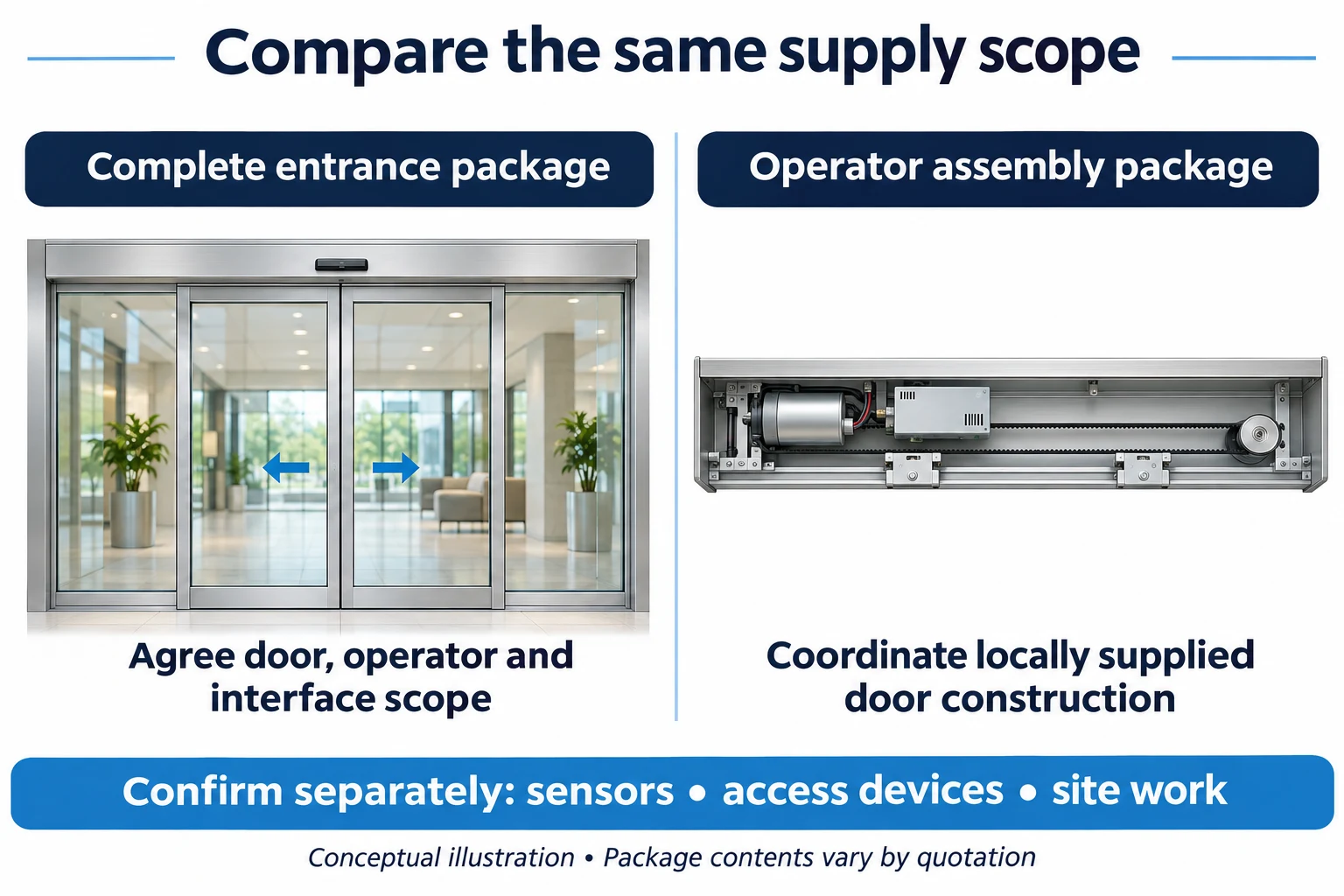
Before comparing brand names, decide what you are buying. Separate three possible scopes: a complete automatic entrance, a complete sliding-door operator system without door leaves, and individual components. Ask each candidate to quote against the same requested boundary.
A complete-door proposal should identify the door leaves and frames where applicable, the operating assembly, sensing and control equipment, and the items supplied by others. The word “complete” still needs an itemized definition. It does not automatically include installation, access-control devices or every building interface.
An operator proposal needs a different review. Your team must coordinate the assembly with the door construction, leaf weight, mounting structure and movement space. Confirm who checks those interfaces and who supplies any required sensors or control accessories. The sliding-door opener guide explains the relevant selection inputs.
Also distinguish brand identity, manufacturing origin, seller and installer. These are separate facts. Ask which company will issue the quotation, which product it will supply, and which organization will take responsibility after delivery. If origin matters to your procurement requirements, request the relevant product documentation rather than inferring it from a brand name.
Six Checks for Chinese and International Brands
Apply the same six checks to every candidate. The two sourcing routes below describe purchasing arrangements you may encounter. A Chinese brand may sell through a local partner, and an international brand may quote equipment without site services. Use the column that matches the actual offer.
| Decision | Buying from a manufacturer for export | Buying through a local brand channel | Evidence to request |
|---|---|---|---|
| Product and project fit | Ask which proposed door construction and operating assembly fit your opening, traffic and control requirements. | Ask which product and configuration are offered in your market, and who confirms suitability for the entrance. | A named configuration, opening drawing and list of unresolved requirements. |
| Included supply | Check whether the offer covers a complete door, an operator assembly without leaves, or individual items. | Separate the brand's equipment from the glazing, profiles and site work supplied by its local sales or installation channel. | An itemized included/excluded list with one owner for each interface. |
| Customization and coordination | Identify who reviews drawings, confirms materials and approves changes before production. | Identify which adaptations the selected system supports and which require manufacturer or local-partner approval. | An approved drawing revision and a written change-confirmation process. |
| Total project cost | Add delivery, import-related charges where applicable, local fabrication, installation, commissioning and support arrangements to the equipment price. | Check whether the local quotation includes installation, commissioning, call-outs or maintenance, and price excluded work separately. | Comparable totals based on the same entrance and responsibilities. |
| Delivery and site readiness | Confirm when production timing starts, what must be approved first, and who handles packing, transport and receipt. | Confirm availability of the specified configuration through the quoted channel, plus the installation team's schedule. | A project-specific timeline that separates manufacture, dispatch, arrival and site completion. |
| After-sales responsibility | Confirm remote support, replacement-part identification and the local team that will inspect or repair the installation. | Verify that the named service provider covers your location and the proposed system under the stated terms. | Named contacts, written warranty terms, parts arrangements and responsibility for site visits. |
On smaller screens, scroll within the table to compare all four columns.
Make project fit a requirement before comparing price
Record the required clear passage, side space, door-leaf construction, expected use and control functions. Then ask each supplier to identify a suitable configuration. A familiar brand name does not resolve an unsuitable opening arrangement or an unconfirmed interface. Where your project requires particular documents or acceptance checks, have the responsible project team specify them before shortlisting.
Compare the cost of reaching the same finished entrance
An equipment-only quotation and a locally installed quotation cover different responsibilities. Add the missing work to each proposal before deciding which has the lower total. Keep one-time purchase and installation costs separate from recurring maintenance or service costs. Ask who pays for diagnosis, replacement freight, site labor and return handling under the proposed warranty terms.
There is no supported country-wide price discount or fixed lead-time advantage to apply here. Use written offers for your configuration and destination. The automatic sliding door cost guide explains the cost drivers, while the supplier quotation comparison guide covers detailed offer review.
Turn “support available” into an assigned responsibility
Ask who will attend the site if the door stops operating, what information the manufacturer needs for remote diagnosis, and how replacement parts will be identified and obtained. For a busy entrance, an unanswered service question can matter more than a small difference in purchase price. Confirm the proposed arrangement with the people who will actually maintain the door.
What Official Brand Information Can Tell You
Product pages establish a useful starting point. They do not replace a project quotation or a local service agreement. These examples show how to turn published information into a specific procurement question.
SEPPES and KBB: check the relevant Chinese-brand offer
SEPPES presents commercial automatic sliding doors and separately supplied complete sliding-door operator systems. Its sliding-door range is the starting point for a configuration discussion. Ask SEPPES to define the door arrangement, supplied equipment and project interfaces in one agreed scope.
KBB publishes a sliding-door product range within its wider entrance portfolio. Use the relevant product information to identify a candidate, then ask which configuration and supply package would be offered for your project. The existence of a product category alone does not settle installation or overseas service responsibilities.
dormakaba: distinguish an operator from the complete entrance
The dormakaba ES 200 product page describes a modular sliding-door operator with additional modules and options. That makes it a useful example of why a named operator is only part of a purchasing decision. Ask the quoting company to identify the door leaves, profiles, sensing devices and installation work supplied with the selected assembly.
GEZE: look for usable technical and service documentation
The GEZE service downloads page links to automatic sliding-door troubleshooting material and service-contract information. When comparing a proposed system, ask which current documents apply to it, who can use the diagnostic tools, and what training the installation or maintenance team needs. A document library is useful evidence of available resources; it does not confirm a service contract for your site.
ASSA ABLOY: verify service at the project location
The ASSA ABLOY Entrance Systems Dallas branch page describes automatic-door products and local service for the Dallas/Fort Worth area. This is a location-specific example of a product-and-service channel. A buyer elsewhere should identify the relevant local office or partner and confirm coverage, included work and contract conditions for that address.
Use brand evidence at the level it supports: a product page for product scope, a technical document for the named configuration, and a regional contact for regional service discussions. For more China-based candidates, see our Chinese automatic sliding glass door brand shortlist.
Choose a Sourcing Route for Your Project
You have a local installation team and need manufacturing coordination
Consider manufacturers that can review your drawings and provide an agreed door or operator package. This route can fit contractors and distributors who already manage site measurement, glazing, electrical work and commissioning. Before ordering, have your installer review the proposed interfaces and confirm access to the information needed for installation and maintenance.
You need one local contact for equipment and site work
Prioritize suppliers able to make a written local installation and service offer. Ask whether the seller performs that work itself or appoints another company, and confirm who remains responsible for coordination. Compare the included services and exclusions alongside the equipment specification. Brand familiarity alone does not establish that arrangement.
Your project specifies a particular brand or system
Start with the approved specification and the party responsible for accepting alternatives. If an alternative is permitted, submit a documented comparison of the proposed door configuration, interfaces and required project evidence. Confirm acceptance before procurement. A general statement that two systems are “equivalent” leaves the project team without a basis for approval.
You want to source the operator and door structure separately
Choose this route only with a clear interface owner. Have the operator supplier and local door fabricator agree the relevant dimensions, construction and mounting conditions before fabrication. Savings from local glass or frame sourcing need to be weighed against the coordination work your team takes on. Keep those responsibilities visible in the purchase scope.
You are developing a distributor or OEM/ODM relationship
Compare the repeat-order process as well as the first sample or project. Ask how configurations are identified, drawing changes are controlled, replacement assemblies are matched and technical questions are handled. Define any requested branding, packaging or documentation requirements for review. Do not assume that an OEM/ODM offer includes every customization you have in mind.
When to Include SEPPES in Your Shortlist
Include SEPPES when you want to discuss a commercial automatic entrance directly with a source manufacturer and OEM/ODM solution provider. The useful starting point is your entrance requirement: a complete project-configured door, or a complete sliding-door operating assembly to coordinate with a separately supplied door structure.
Two supply routes for sliding-door projects
Complete automatic door systems remain SEPPES' primary focus. SEPPES also supplies complete automatic sliding door operator systems separately, without door leaves. Review the assembly contents, compatible door construction, mounting conditions and required interfaces for each order. Sensors, access devices, frames and other items must be confirmed in the itemized quotation.
Individual components and accessories generally serve existing customers' replacement, spare-part and repair needs. Larger standalone component orders can be reviewed separately according to the item, quantity and compatibility. This separate parts policy does not impose an existing-customer condition on complete sliding-door operator systems.
Configuration and remote technical coordination
SEPPES can discuss sliding-door arrangements including bi-parting, telescopic, all-glass, aluminum-framed and surface-mounted configurations. The appropriate choice depends on the opening and project requirements. The customization planning guide explains which inputs need confirmation before production.
Support includes online installation guidance and remote troubleshooting, with replaceable spare parts supplied under the policy above. Your project still needs an assigned team for site installation, commissioning and local maintenance. If you require a supplier to provide on-site service, establish that arrangement separately before treating any proposal as complete.
For supplier verification, review SEPPES company and manufacturing information and relevant automatic entrance project cases. Use those records to frame questions about your own project; confirm its configuration, delivery schedule and commercial terms in the proposal.
Questions to Resolve Before Shortlisting
Are Chinese automatic sliding door brands always cheaper?
A country label does not establish the final project cost. Compare quotations for the same door construction, equipment and responsibilities, then include transport, any applicable import charges, installation, commissioning and maintenance arrangements. An operator-only price cannot be compared directly with a complete installed entrance.
Does an international brand automatically include local installation?
No. Confirm the legal entity making the offer, the installer and the service provider for your project location. A regional branch page can help identify a contact, but the quotation or service agreement needs to state the work included and its conditions.
Can I replace an existing operator with a different brand?
A brand change requires a technical review of the existing door construction, leaf weight, track and mounting conditions, sensors and control interfaces. Send drawings, labels and photographs for assessment. A matching cover size or similar product name does not establish compatibility.
Can SEPPES supply the operator while we source the glass locally?
Yes. SEPPES can supply a complete automatic sliding door operator system separately, without door leaves. Agree the compatible door construction, mounting conditions, assembly contents and sensing or access-control requirements before ordering. Local glass and frame work must follow the agreed interfaces.
Send Each Brand the Same Project Brief
A useful shortlist ends with suppliers responding to the same entrance requirement. Prepare the information below, identify anything still undecided, and ask each candidate to confirm its proposed scope in writing.
- Project and location: building use, country, delivery destination, quantities and required project dates.
- Opening and construction: opening width and height, required clear passage, side space, mounting conditions, drawings and site photographs.
- Door and operation: preferred opening arrangement, glass and frame direction, traffic needs and any existing access-control equipment.
- Supply boundary: complete door or operator assembly, items sourced locally, and responsibility for interface confirmation.
- Site and support: the installation team, commissioning responsibility, maintenance contact and requested spare-parts arrangements.
- Project evidence: specified documentation and acceptance requirements, with unresolved decisions clearly identified.
You can use the automatic door quotation checklist to organize a more detailed inquiry. To evaluate SEPPES for your shortlist, send the brief and available drawings. Our team can review the requested configuration and supply scope with you.