
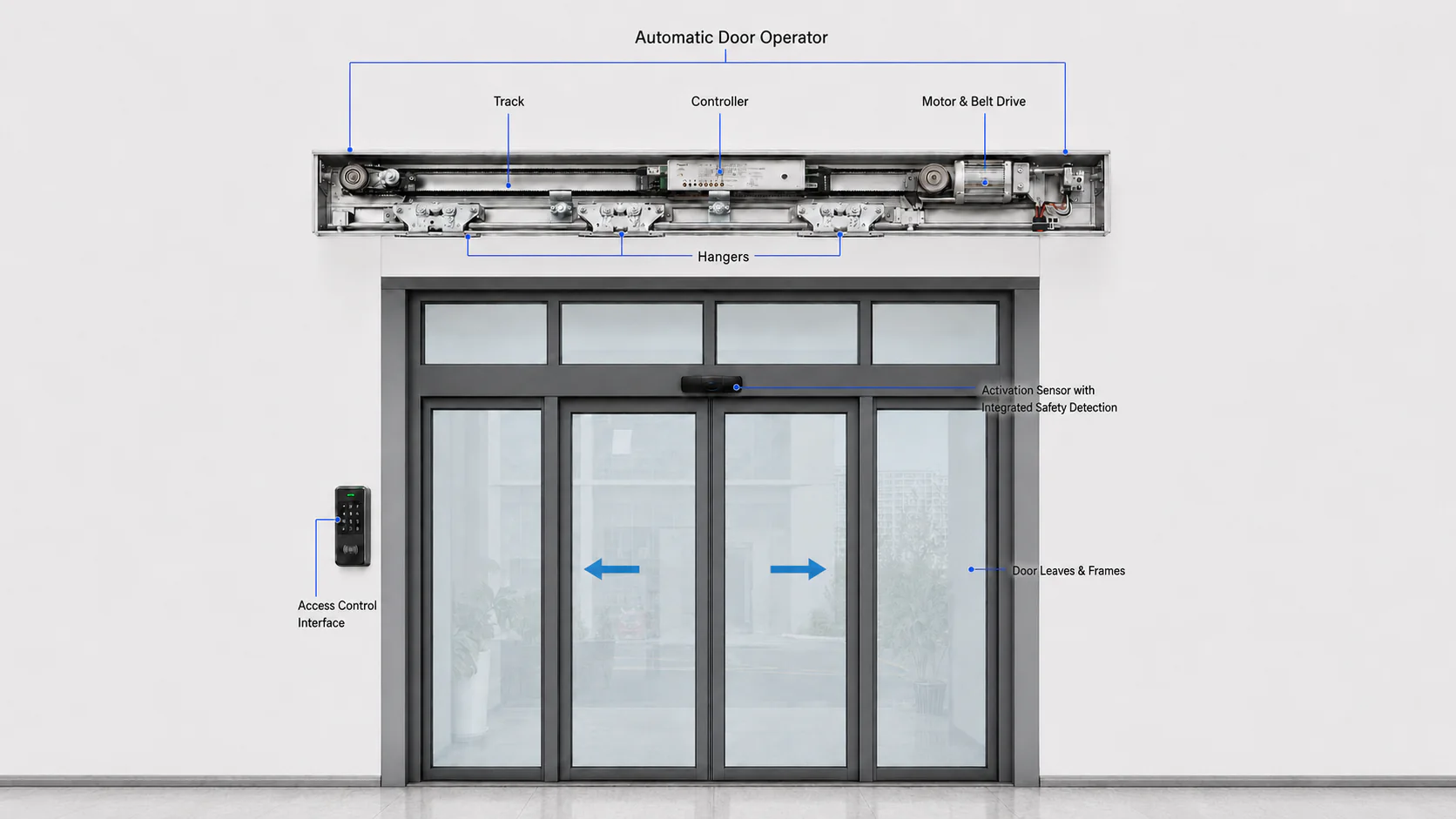
Main Components at a Glance
The main automatic sliding door components are the operator assembly, motor and drive, controller, power supply, track, hangers, guiding hardware, sensors, operating inputs and door structure. Together, they support the leaves, move them and coordinate the response to people and connected controls.
If you are comparing a package or identifying a part for an existing entrance, start with its role. A motor is not the entire operator, and an operator is not the complete door. This distinction matters when equipment supply and local fabrication belong to different companies.
Operator assembly
The powered assembly that brings the drive, control and supporting hardware together.
Motor and belt drive
The motor provides rotation; the drive transfers movement to the door-leaf carriers.
Controller and power supply
The controller coordinates connected signals and movement. The power supply serves the selected electrical equipment.
Track, hangers and guides
The track and hangers support horizontal travel; the specified guides keep the leaves on their intended path.
Sensors and operating inputs
Activation requests, presence detection and intentional controls give the controller different kinds of information.
Door leaves, frames and interfaces
The moving panels form the passage and connect the equipment to the surrounding construction.
For every group, establish three things: what it does, what it connects to and who supplies it. Locks, mode selectors, batteries and interface accessories need their own confirmation where required.
The sections below explain the parts. For the chronological opening and closing sequence, read How Do Automatic Sliding Doors Work?
The Operator, Motor and Drive Assembly
The operator is an assembly, not another name for the motor. Understanding that distinction helps you read a component list without assuming that every item is a separate purchase.
The operator brings the powered hardware together
An automatic sliding door operator is the powered assembly selected to move the door leaves. Depending on the design, it houses or coordinates the motor, controller, drive and track-related hardware. The cover is the visible enclosure, not a complete description of what sits inside or what ships with it.
For a contractor supplying locally fabricated glass leaves, an operator package can form one part of the entrance. Its suitability still depends on the moving weight, leaf arrangement, available mounting space and required functions. Compare the itemized package and the installation requirements, not just the housing length or product label.
The motor produces movement; the drive transfers it
In the belt-driven arrangement shown above, the automatic sliding door motor produces rotation that the drive transfers to a belt. Connections between the belt and the moving carriers turn that motion into horizontal door travel. The motor, belt, pulleys and carrier attachments work together rather than acting as independent accessories.
An automatic sliding door belt must match the intended drive assembly. Its dimensions, attachment arrangement and adjustment method cannot be selected by appearance alone. The same applies to a replacement motor: electrical connections and mounting points are only part of the compatibility review. The controller and the load being moved also matter.
The Controller, Power Supply and Operating Inputs
The mechanical drive needs instructions as well as power. Keep the controller, the power supply and the user's operating controls separate when discussing what the package includes.
The controller coordinates the response
The automatic sliding door controller receives opening requests, connected detection signals and operating-mode inputs. It uses the configured logic to coordinate the drive and any supported locking or access functions. What it can do depends on the selected controller, connected devices and agreed configuration.
For example, a lobby may use automatic activation during opening hours and an authorized access request at other times. That requirement involves more than adding a card reader. The project team needs to define which requests are accepted in each mode and how the lock and detection inputs interact with them.
Power and mode selection have different jobs
The power supply provides the electrical supply required by the selected equipment. It may be integrated into the operator assembly or supplied as a separate unit. The incoming supply, accessory loads, cable routes and isolation arrangements belong in the project documentation; this guide does not prescribe electrical ratings or terminal connections.
A mode selector is the user-facing control for the operating choices supported by that system. It is not the main controller board. A switch or display can let staff select an available mode, while the controller carries out the corresponding logic. Battery backup and behavior during a power interruption also need explicit configuration review rather than an assumption based on the word automatic.
The Track, Hangers and Door-Leaf Guidance
The door leaves need a supported, aligned travel path. A drive cannot compensate for a mechanical arrangement that does not match the opening or the moving panels.
Track and hangers support the moving leaves
The automatic sliding door track provides the path for the hanger or roller assemblies. The hangers connect the moving leaves to that support arrangement. In the illustrated system, these parts sit above the doorway; the surrounding structure must support the specified assembly and leave room for its intended travel.
The required hardware arrangement changes with the door layout. A single-slide entrance moves a leaf toward one side, while a bi-parting entrance moves leaves away from the center. Telescopic doors coordinate multiple panels. These differences affect carrier positions, drive connections and available travel space, so one hardware list should not be assumed to suit all three.
Guidance extends beyond the overhead track
Depending on the door construction, floor guides or other guiding hardware help keep the lower part of the leaf on its intended path. Brackets, stops and mounting details also vary by design. These items may be less prominent than the operator, but they need an assigned supplier and an approved position in the installation drawings.
For a retrofit, share photographs of the existing guidance and finished floor as well as the header. This gives the fabricator and installer a clearer basis for checking how new equipment will meet the existing door structure. Alignment, clearances and adjustment remain matters for the selected system's installation instructions.
Activation and Safety Sensors
Opening requests and presence detection have different purposes. Treat them as separate functions even when one sensor housing provides both.
Define what each input tells the controller
An activation input requests opening. A presence or safety-related input reports a condition within a defined monitored area so the controller can apply the configured response. A device at the entrance is therefore not a complete detection plan: its function, position, monitored area and connection to the controller all need to be understood.
An automatic sliding door sensor should be reviewed against approach routes, the doorway and the movement of the leaves. For example, people approaching from the side present a different planning question from people standing in the passage. The required response and the areas to be monitored need to be established for the actual entrance.
Access devices do not replace passage detection
A push button or access-control device may request or authorize opening. That does not make it a substitute for the sensing functions specified for the moving doorway. Identify which system provides each signal and who is responsible for the interface, cabling and functional testing.
Sensor type alone does not prove coverage, compatibility or compliance. Device selection, positioning and commissioning require the applicable product documentation and project review.
See Automatic Door Sensor Types Explained for the differences between detection functions and technologies.
Door Leaves, Frames and Building Interfaces
An operator package does not create the finished passage by itself. The door construction and the surrounding building determine what the equipment must move and where it can be installed.
The moving panels define the load and passage
Door leaves, their frames and the selected fittings contribute to the moving weight and attachment arrangement. Fixed panels and the surrounding frame define the rest of the opening. An all-glass appearance and a framed construction can require different fixing details even when the entrances look similar from a distance.
Use the finished opening, required clear passage and available panel travel as separate pieces of information. A photograph of the storefront can explain the setting, but it does not replace dimensions or a coordinated door drawing. If the leaves are fabricated locally, both suppliers should work from the same approved revision.
Assign the connections to the building
The entrance also needs mounting support, power preparation, cable routes and space for inspection or adjustment. These are interfaces between equipment supply and site work. They should have named responsibilities even when they sit outside the door supplier's quotation.
A useful review brings the door fabricator, operator supplier, installer and access-control team onto the same scope. It establishes who provides each item, what information passes between the parties and who verifies the assembled entrance. A complete set of parts still needs coordinated installation and commissioning.
Compare the available automatic sliding door configurations before finalizing the component arrangement.
Complete Door System, Operator Package or Replacement Parts?
A quotation can cover an entire entrance, a powered package for locally supplied leaves, or one identified component. Those are different supply scopes even when some part names appear in all three. The table is a review framework, not a standard inclusion list.
| Supply scope | May include, if agreed | Buyer or site inputs | Confirm before order |
|---|---|---|---|
| Complete entrance system | Agreed door leaves and frames, operator and drive, controller, track hardware, selected sensors and specified accessories. | Site measurements, surrounding construction, power preparation and any installation or external systems outside the quotation. | Which party owns fabrication, mounting, cabling, integration, commissioning and final site acceptance. |
| Operator package | Motor and drive, controller, track-related hardware and the sensors or operating accessories specifically listed in the package. | Compatible door leaves and frames, moving-weight information, fabrication drawings, mounting structure and site installation. | The itemized package contents, door-fabrication requirements and all locally supplied hardware. |
| Selected components or replacement parts | The identified, technically reviewed component and any explicitly listed matching accessories. | Existing system identification, component labels, photographs, available connection records and the observed issue. | Compatibility, included connectors or brackets, effects on settings and responsibility for installation and testing. |
On smaller screens, scroll within the table to compare all four columns.
For example, one proposal may include sensors while another leaves them to the installer. Neither total explains that difference on its own. Request an itemized list and put exclusions beside inclusions so that an omitted device does not become an unassigned site responsibility.
The Automatic Door Systems overview explains the broader supply directions. This component guide helps you check the connections within the direction you choose.
What to Confirm Before Selecting or Replacing Components
For a new entrance or operator package
Give the supplier enough information to connect the equipment to the finished opening. Drawings and site photographs help explain constraints that a part name cannot show. Start with these inputs:
- Finished opening dimensions, required clear passage and available side space.
- Leaf arrangement, construction, moving-weight information and mounting details.
- Required activation, detection, access-control and operating-mode functions.
- Power preparation, cable routes and responsibilities for external equipment.
- Whether you need a complete entrance, an operator package or identified replacement parts.
If some information is provisional, identify it as such. An estimated moving weight or an unfinished opening should not quietly become the basis for final equipment selection. For the wider project checklist, use the automatic door quotation preparation guide.
For an existing installation
For drive and controller interfaces, service access and support for an earlier SEPPES order, see the Automatic Door Operator guide.
Requests for automatic sliding door parts need a clear record of the existing system. Work through these checks before confirming a replacement:
Identify the existing equipment
Provide operator and component labels, available model information and clear photographs. A description such as sliding door motor is a starting point, not a compatibility check.
Describe the observed issue
Explain what the door does, when the issue occurs and which function you need to restore. A symptom alone does not establish which part has failed.
Review interfaces and included accessories
Share available connection records and ask whether the proposed item requires matching brackets, cables, connectors or setting changes. Similar appearance does not establish interchangeability.
Arrange installation and verification
A qualified installer should follow the applicable instructions for isolation, replacement, adjustment and testing. Verify the affected movement, sensing and operating functions before returning the entrance to use.
SEPPES prioritizes complete doors. Operator systems, components and accessories are generally supplied to existing customers as replacement, spare or repair parts, with remote online support. Standalone requirements involving hundreds or thousands of sets can be discussed separately. Share the earlier order and equipment information so we can review the scope and compatibility. Local installation and site testing need a separately agreed responsible party.
Frequently Asked Questions
What are the main components of an automatic sliding door?
The main groups are the operator, motor and drive, controller and power supply, track and hangers, guiding hardware, sensors, operating inputs, door leaves and frames. The exact arrangement and included accessories depend on the selected system and written supply scope.
Is the operator the same as a complete automatic sliding door?
No. The operator is the powered assembly that moves and controls the leaves. A complete entrance also involves the specified door structure, detection equipment, interfaces and installation coordination. Check the itemized quotation because package names do not establish identical contents.
Is a mode selector the same as the door controller?
No. A mode selector is the user-facing control for choosing supported operating modes. The main controller receives that input and coordinates the configured response with the drive and other connected devices.
Are sensors included with an automatic sliding door operator?
They may be included in an agreed package, but the operator name alone does not confirm their quantity or function. Ask for the device list and establish the required activation and monitored areas before treating the package as complete.
Can automatic sliding door parts be replaced separately?
Selected parts may be replaced after the existing system and proposed replacement have been reviewed for compatibility. Identify the equipment, interfaces and required accessories, then arrange installation and functional testing. A similar housing or connector is not enough to confirm a match.
From a Parts List to a Coordinated Entrance
A useful automatic sliding door components review connects the parts to the project: the operator to the moving leaves, the controller to the required inputs, and the supplied equipment to the work performed on site. A familiar part name cannot settle those connections by itself.
Share your available drawings, door arrangement, control requirements and preferred supply scope. For an existing door, include equipment labels and photographs. We can use that information to discuss the package or parts you need and identify the details that require technical confirmation.