

Direct Answer
An automatic sliding door converts an opening request into controlled horizontal door movement. An activation sensor, button, access-control device or building interface sends the request to the controller. The controller then directs the motor and belt drive, moving the suspended door leaves along the track.
Sensing and control logic continue to coordinate the entrance during passage and closing. The finished cycle depends on the selected operator, door-leaf arrangement, detection package, operating modes and building interfaces. These parts therefore need to be reviewed as one entrance system.
Signal to Movement
How an Automatic Sliding Door Works Step by Step
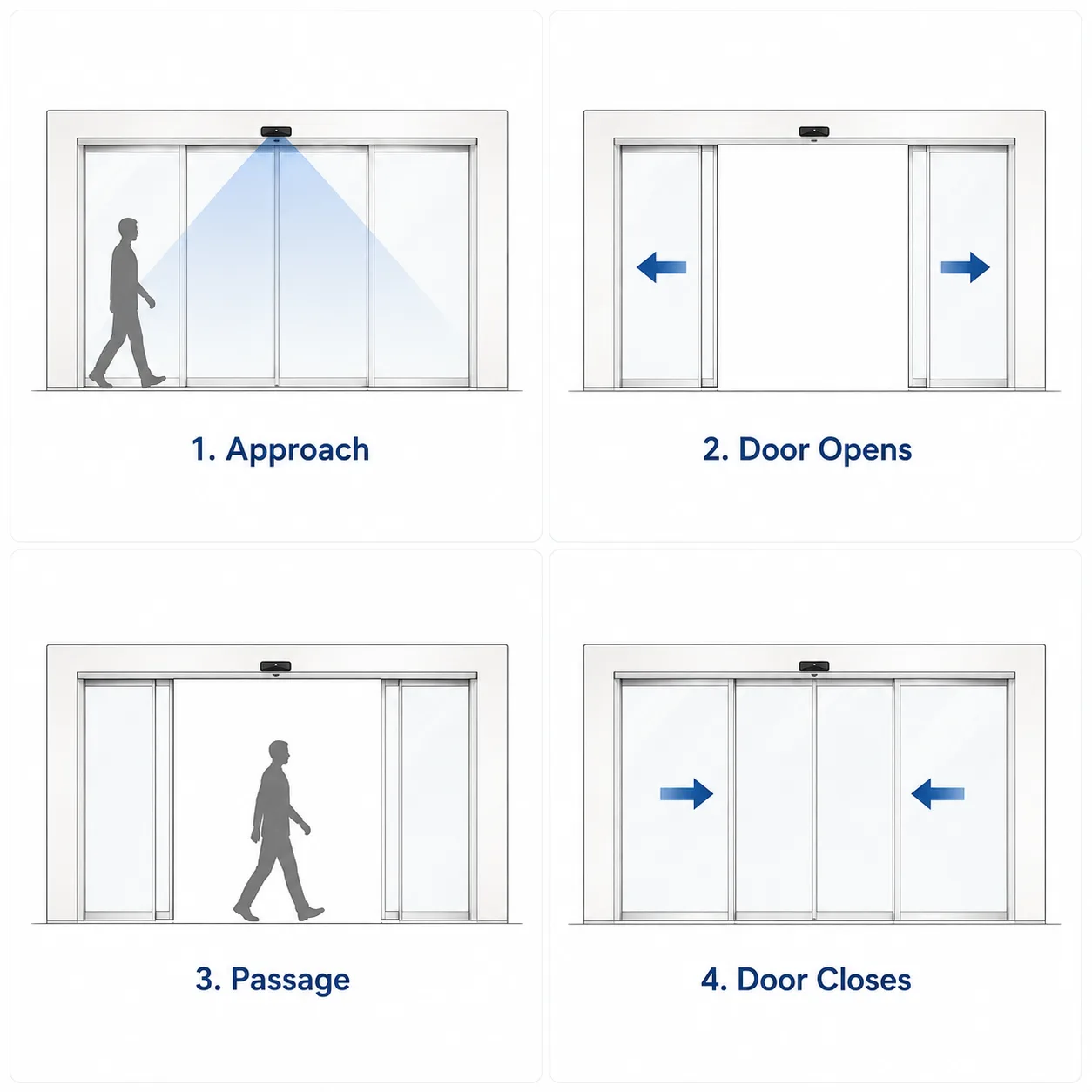
The visible action looks simple: someone approaches, the door opens and it closes after the person passes. Behind that motion is a sequence of signals and mechanical actions. Reading the sequence in order makes it easier to understand which part is responsible for each stage.
An opening request reaches the controller
An activation sensor can detect an approaching user. A push button, access-control device or building interface can also send an opening request when that input is part of the agreed system.
The controller interprets the request
The controller checks the incoming signal against the selected operating mode and connected inputs before issuing a movement command.
The drive creates horizontal movement
The motor and belt drive convert the controller command into lateral movement. The exact drive arrangement belongs to the selected operator system.
The leaves travel along the track
Hangers support the moving leaves while the track guides their travel. The leaf arrangement determines whether one panel moves to one side, two panels separate from the center or multiple panels stack in sequence.
Sensing supports the passage phase
Presence and safety detection can monitor the doorway or moving area according to the selected sensor package and project design. Connected logic can keep the entrance open while the passage remains occupied.
The controller commands closing
After the required hold-open condition is met and the connected detection logic permits the cycle to continue, the controller directs the leaves to close under controlled movement.
System Roles
What Each Part Does During the Door Cycle
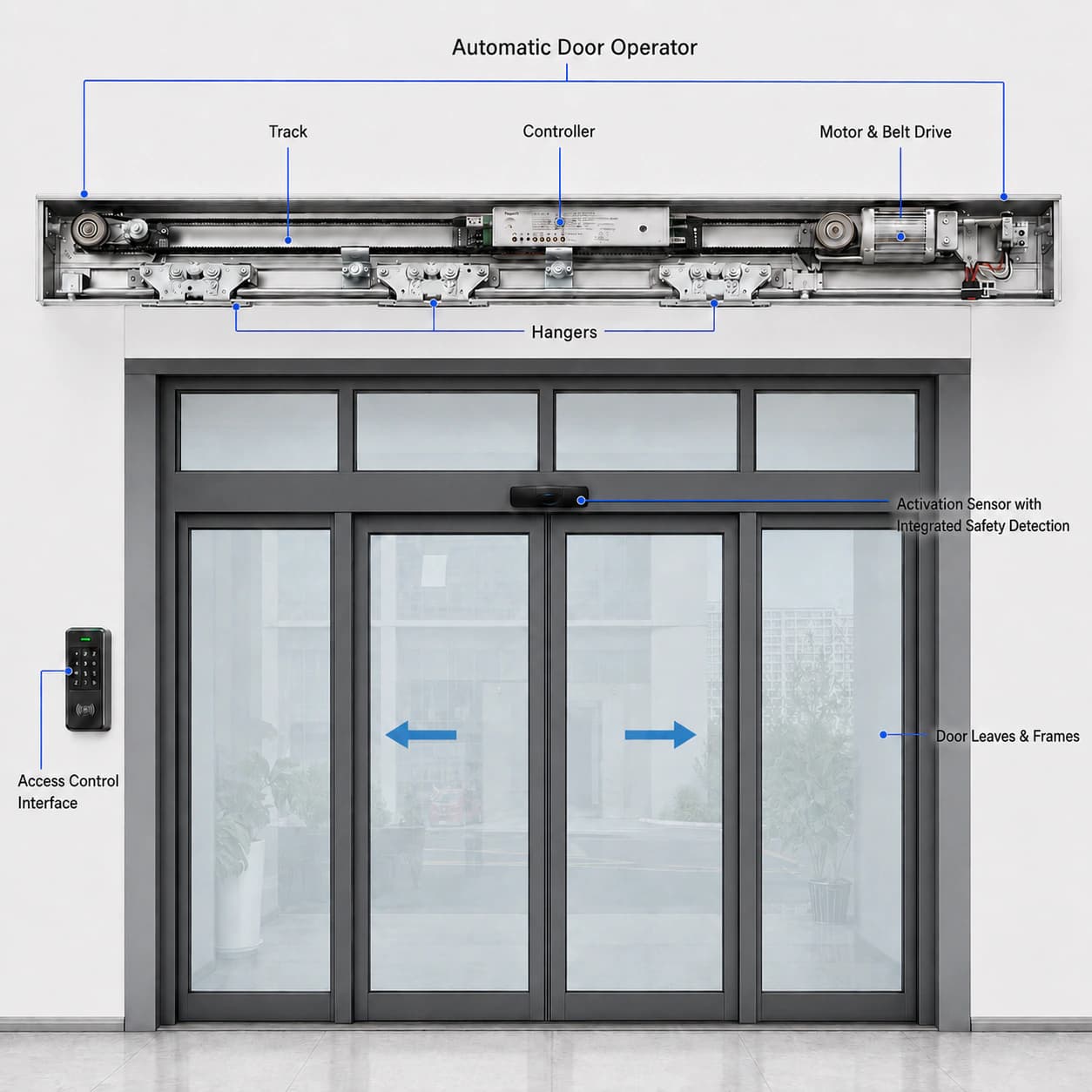
The automatic sliding door mechanism is more than the operator above the opening. The drive can only move an entrance that has suitable leaves, track geometry and supporting construction. The controller also needs usable input from sensing devices and any connected access system.
Operator assembly
The operator houses the drive and control elements that create and manage door movement. Its suitability depends on the leaves, opening geometry and project scope.
Controller
The controller receives input signals and coordinates opening, hold-open, closing, locking logic and connected operating modes.
Motor and belt drive
The motor supplies the driving force. The belt transfers that movement to the door-leaf carriers so the leaves can travel horizontally.
Track and hangers
The hangers carry the moving leaves, and the track defines their travel path. These elements must be coordinated with the leaf arrangement and available movement space.
Sensing devices
Activation sensing requests movement. Presence and safety detection support monitoring around the passage and moving area according to the selected design.
Door leaves and frames
The moving leaves form the passage. Fixed panels, framing, glass and the surrounding structure determine the finished geometry and appearance.
Ask what is included in the operator package and what must be supplied, installed or connected by others. The same product name can describe different supply boundaries.
Sensors and Control
Activation and Safety Detection Have Different Jobs
Activation answers the first question in the cycle: has a valid request to open reached the controller? A sensor may detect an approaching pedestrian, while a button or access-control device can provide a deliberate request. The controller uses that input together with the selected operating mode.
Presence and safety detection support a different part of the sequence. Their role is to monitor defined areas around the passage or moving leaves according to the chosen sensor package and project design. The detection zones, mounting positions and resulting door behavior need to suit the actual entrance.
It is therefore risky to treat every device above a doorway as the same type of sensor. An entrance may need more than one sensing function, and the controller must be configured to use each input correctly. Final coverage and operation should be checked during system adjustment and project testing.
Movement Arrangements
The Working Principle Changes With the Leaf Configuration
Automatic sliding doors share a broad operating cycle, but the mechanical movement is not identical. The opening size, required clear passage and available side space help determine which arrangement should be reviewed.
Single-slide
One moving leaf travels toward one side. The building must provide a suitable travel area beside the clear opening.
Bi-parting
Two moving leaves separate from the center and travel in opposite directions. The controller coordinates both sides as one opening cycle.
Telescopic
Multiple leaves move and stack in sequence. This changes the mechanical arrangement and must be reviewed against the available side space and required passage.
Surface-mounted
The operator and track are coordinated with an existing wall or framed opening. Structure, leaf travel, wiring and installation interfaces need project review.
A bi-parting entrance moves two leaves away from the center. A telescopic entrance coordinates multiple panels so they can stack in sequence. A surface-mounted system depends on the existing structure and usable travel area. These differences affect the track, hangers, drive connection and project interfaces even though the controller still manages a request, opening phase, passage phase and closing phase.
Compare Sliding and Revolving Door MovementConnected Operation
Access Control and Operating Modes Shape the Sequence
A public entrance may open when an activation sensor detects an approach. A controlled entrance may wait for an authorization signal before the controller begins the same mechanical cycle. The access device does not move the leaves itself; it supplies an input that the door controller must recognize and coordinate.
Public, restricted, locked and hold-open conditions can require different input and release logic. If the entrance connects to a building access system, define which party provides the signal, lock, cabling and programming. Also define who tests the complete sequence after installation.
Emergency and code-related behavior depends on the applicable project requirements and selected system. It should be reviewed by the responsible project professionals and authorities rather than inferred from a general description of automatic sliding door operation.
Explore Automatic Door SystemsProject Coordination
A Reliable Cycle Depends on the Complete Entrance
Understanding how automatic sliding doors work is useful during selection because the cycle exposes every interface that needs a project decision. The controller cannot compensate for unsuitable leaf travel, missing structural support or an undefined access signal. A sensor cannot confirm coverage that was never planned for the opening.
Prepare the following information before asking a manufacturer to confirm a configuration or supply scope:
- Finished opening width and height
- Required clear passage and preferred leaf arrangement
- Available side space and travel distance
- Door-leaf construction and moving weight
- Activation, presence and safety-detection requirements
- Access control, locking and operating-mode requirements
- Power, wiring and building-interface conditions
- Complete entrance package or operator-only supply scope
- Installation, adjustment, testing and commissioning responsibility
For a retrofit, add photographs of the header, sides, floor and nearby ceiling. Mark the opening and travel dimensions on a sketch or image. For a new entrance, provide the relevant plan, elevation and interface notes. This information allows the operator, leaves, sensing and building work to be reviewed together.
Read the Commercial Entrance Selection GuideCommon Questions
Frequently Asked Questions
What tells an automatic sliding door to open?
The opening request may come from an activation sensor, push button, access-control device or connected building interface. The controller receives that request and applies the programmed operating logic.
How does an automatic sliding door know when to close?
The controller manages hold-open and closing logic using the selected operating mode and connected sensing inputs. The exact sequence depends on the sensor package and project design, so it should be confirmed as part of the complete system.
What is inside an automatic sliding door operator?
A typical operator assembly coordinates elements such as the controller, motor, belt drive and track-related hardware. The exact assembly and included parts vary by operator and supply scope.
Can an automatic sliding door connect to access control?
It can when the required interface, authorization signal, locking logic, release conditions and testing responsibility are defined for the project.
What happens if someone remains in the doorway?
Where the selected sensing and control design monitors the occupied passage, the connected logic can hold or modify the door cycle. Detection coverage and final behavior must be confirmed for the actual entrance rather than assumed from the door type alone.
Do all automatic sliding door mechanisms work the same way?
They share the same broad signal-to-movement principle, but leaf arrangement, operator design, sensing package, access interfaces and project settings can change how the complete entrance operates.
Final Review
Specify the Cycle as a Coordinated System
The basic working principle is a chain: input, controller decision, driven movement, monitored passage and controlled closing. The quality of the finished entrance depends on how well that chain fits the door leaves, opening geometry, user flow and connected building systems.
When requesting a recommendation, describe the full entrance and the expected operating sequence. This gives the supplier enough context to identify which items can be confirmed and which still require project-specific review.