
Direct Answer
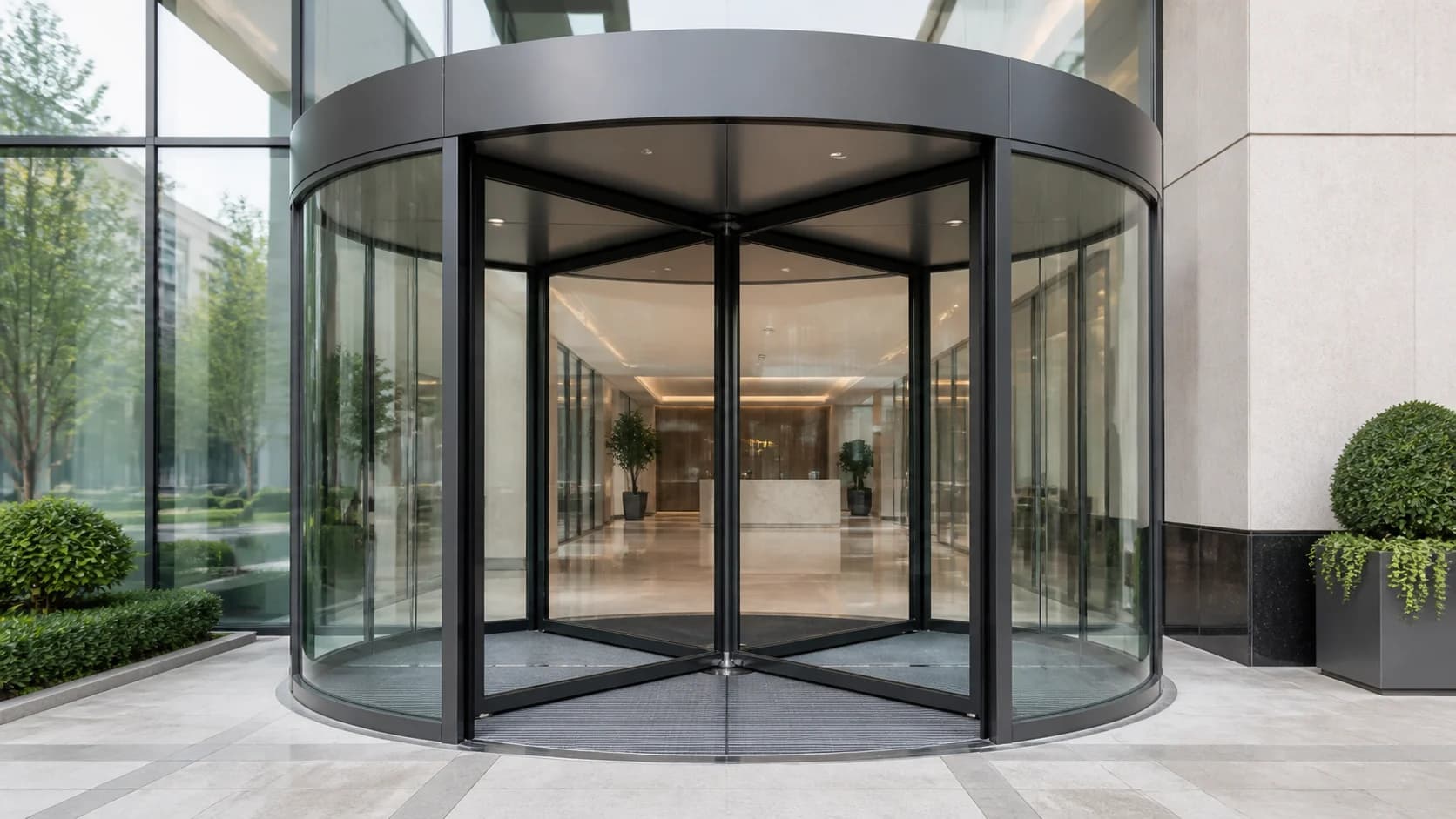
Automatic revolving doors work by coordinating an activation request, controller logic and a powered rotating assembly. When an approved input reaches the controller, the operator turns the central shaft and connected wings through a fixed drum enclosure. The moving wings form compartments that carry people from one side of the entrance to the other.
Presence and safety devices monitor defined areas while the door moves. The controller uses those inputs, together with the selected operating mode, to manage the next drive command. The final sequence therefore depends on the complete entrance design, not on the motor alone.
Operating Cycle
How an Automatic Revolving Door Works Step by Step
The door appears to make one continuous circular movement, but the control system processes several distinct stages. This signal-to-passage sequence explains what changes between an approaching pedestrian and the next operating state.
An Approach Creates an Activation Request
An activation sensor can detect an approaching pedestrian and send a request to the controller. A push button, access-control device or approved building interface can also start the sequence when included in the project design.
The Controller Evaluates the Request
The controller interprets the request together with the selected operating mode and relevant system inputs. It determines whether the rotating assembly should start, continue at a configured state or wait.
The Drive Rotates the Wing Assembly
The automatic revolving door operator uses its motor and drive arrangement to turn the central shaft and connected wings in the confirmed direction. The controller manages that motion according to the selected system.
A Compartment Moves Through the Entrance
The wings divide the drum enclosure into moving compartments. A pedestrian enters an available compartment, follows its circular path and leaves through the opening on the opposite side.
Detection Monitors Defined Zones
Presence and safety devices monitor the approach, threshold or rotating path defined for the selected entrance. Their signals allow the controller to modify movement when the confirmed control logic requires it.
The System Continues or Returns to Its Next State
After the passage, the controller may continue rotation, reduce movement, move to a starting position or wait for another request. The exact response depends on the controller, operating mode and project configuration.
The visible rotation is the output. The controller, sensing package and selected operating program determine when that output starts, changes and ends.
Functional Roles
What Each System Element Does During Rotation
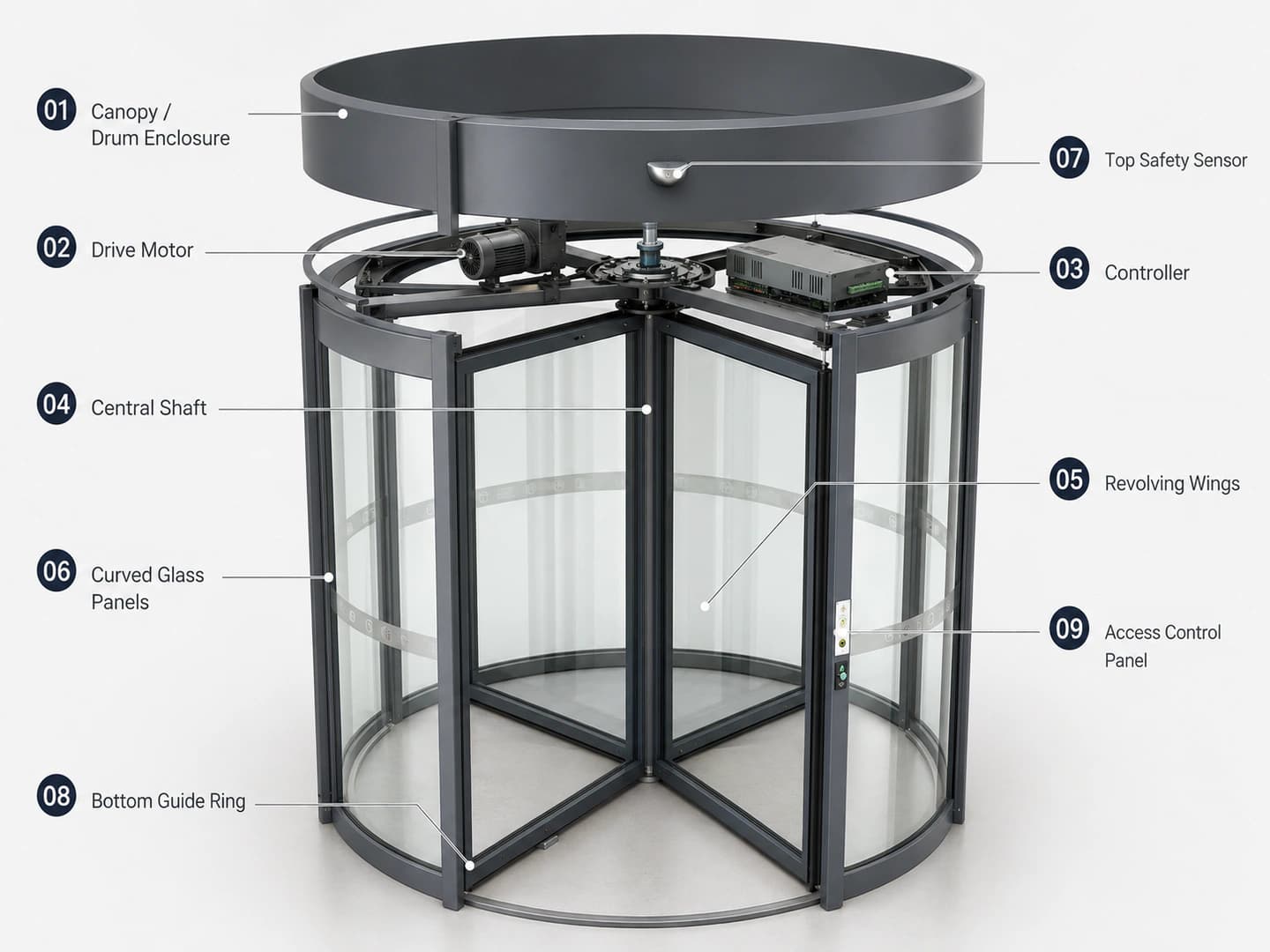
An automatic revolving door operator supplies controlled movement, but it is only one part of the entrance. The structure, wings, controller, sensing devices and building interfaces must work as a coordinated system.
Activation Inputs
Approach sensors, push buttons, access-control devices or agreed building signals provide the initial request. They do not directly power the revolving assembly.
Controller
The controller coordinates activation, operating mode, drive commands, monitored zones and approved external signals. Its programmed logic connects the electrical inputs to the mechanical response.
Operator and Drive
The operator package provides controlled mechanical movement. It must be selected for the revolving structure and project conditions rather than treated as a complete entrance by itself.
Central Shaft and Revolving Wings
The central structure transfers rotation to the wings. Together, the wings form the moving compartments that organize passage through the enclosure.
Canopy, Drum and Floor Interface
The fixed enclosure defines the circular path and connects the drive zone, curved glazing, façade, ceiling and finished floor. Alignment affects the complete system as well as its appearance.
Presence and Safety Devices
These devices monitor confirmed areas around the entrance and rotating path. Their location and response must match the selected controller, entrance geometry and project requirements.
Before comparing proposals, confirm whether the quotation covers the complete revolving entrance, an operator package or another defined supply boundary.
Detection Logic
Activation and Safety Detection Have Different Jobs
Activation starts with a request. An approach sensor may detect a pedestrian, while a push button, card reader or building interface can provide a deliberate input. The controller evaluates that request according to the current operating mode.
Presence and safety detection support movement monitoring. The selected devices can monitor confirmed areas around the approach, threshold, enclosure or moving wings. Their signals inform the controller, but the exact drive response depends on the approved sensor layout and programmed logic.
This distinction matters during specification. Asking only for “a sensor” does not define where detection is required, which condition it should identify or how the controller should respond. Those details need to be recorded for the selected entrance.
Review Automatic Door System InterfacesControl Programs
Why Automatic Revolving Doors Do Not All Operate the Same Way
The basic mechanism remains rotational, but the sequence can change with the selected controller and operating program. Project teams should define the expected behavior instead of assuming one universal automatic mode.
Sensor-Started Operation
The door waits in its selected starting state until an activation request reaches the controller. What happens after the user leaves the detection area depends on the configured program.
Confirm the start position, direction, response after passage and expected peak-traffic behavior.
Continuous or Low-Speed Operation
Some selected systems can maintain rotation or a lower positioning movement instead of waiting at a complete standstill. This is a controller and project decision, not a universal revolving-door behavior.
Confirm which operating modes are included and who is authorized to change them.
Access-Controlled Operation
An approved access signal can release or restrict passage in one or both directions when the selected controller supports the required logic. The access system and door controller need an agreed signal boundary.
Confirm the signal type, direction logic, cabling, testing and responsibilities before production.
Access-control integration is an interface decision. Confirm the signal type, direction logic, cabling and responsibilities with both the door-system and access-control parties.
Passage Geometry
Wing Arrangement Changes the Compartment, Not the Core Cycle
Two-wing, three-wing and four-wing arrangements all use controlled rotation inside an enclosure. What changes is the compartment geometry, the surrounding structure and the way users move through the available passage.
Two-Wing Arrangement
A two-wing system can create a different compartment and central-area layout. Its structure, passage planning and selected product design require project review.
Three-Wing Arrangement
Three wings divide the rotating enclosure into three moving compartments. The available passage and user route still depend on the complete diameter and entrance geometry.
Four-Wing Arrangement
Four wings create four smaller compartments within the same general circular principle. The arrangement must be considered together with traffic, luggage, trolleys and the adjacent accessible route.
A larger or differently divided enclosure does not create a valid selection by itself. The project team still needs to review pedestrian flow, luggage and trolley movement, lobby circulation, the adjacent accessible route and the available footprint.
Compare Sliding and Revolving Door ConditionsProject Coordination
A Reliable Operating Sequence Starts With Complete Project Inputs
The same working principle can produce different project results when the geometry, users, control requirements or supply boundary changes. A useful system review therefore begins with drawings and operating requirements rather than an isolated operator model.
- Entrance diameter, clear height, canopy zone and available footprint
- Approach direction, lobby circulation and expected peak pedestrian flow
- Users carrying luggage, using trolleys or needing an adjacent accessible route
- Wing arrangement, glazing, metal finish and façade coordination
- Activation method, monitored zones, operating modes and emergency controls
- Access-control, power, cabling and other building-system interfaces
- Finished-floor, waterproofing, drainage and installation responsibilities
- Complete-door scope, operator-only scope and work supplied by other parties
These inputs help the door supplier, façade contractor, electrical team, access-control integrator and project manager define compatible responsibilities. They also make it clear which functions remain subject to technical review.
Review the Commercial Entrance Selection MethodFAQ
Frequently Asked Questions
Do automatic revolving doors rotate continuously?
Not always. A selected system may start after an activation request, maintain a positioning movement or operate continuously in a configured mode. Confirm the available modes and switching responsibilities for the proposed controller.
What makes an automatic revolving door slow or stop?
The controller changes the drive command in response to the selected operating program and relevant sensor or control inputs. The exact response depends on the approved sensor layout, controller logic and door configuration.
Can an automatic revolving door connect to access control?
Yes, when the selected controller and project scope support the required signal. The access direction, release logic, interface type, cabling and testing responsibilities should be confirmed before production.
Does changing the number of wings change the working principle?
The core sequence remains similar: a controller manages driven rotation while sensing devices monitor the selected entrance areas. The wing arrangement changes the compartment geometry, passage conditions and structure that the project team must review.
What information is needed to select the operating system?
Share the entrance drawings, available footprint, traffic pattern, accessibility route, desired operating modes, access-control requirements, power and cabling conditions, finish direction, supply boundary and destination.
From Principle to Project
Specify the Entrance as One Coordinated System
The working principle is straightforward: inputs reach the controller, the drive rotates the wing assembly and monitoring devices inform the next response. The project work lies in matching that sequence to the entrance geometry, expected users, operating modes, interfaces and supply responsibilities.
Share the opening and lobby drawings, traffic pattern, accessibility route, control requirements and intended supply scope before choosing the final system. SEPPES can review those inputs as part of a revolving entrance discussion.