
Direct Answer
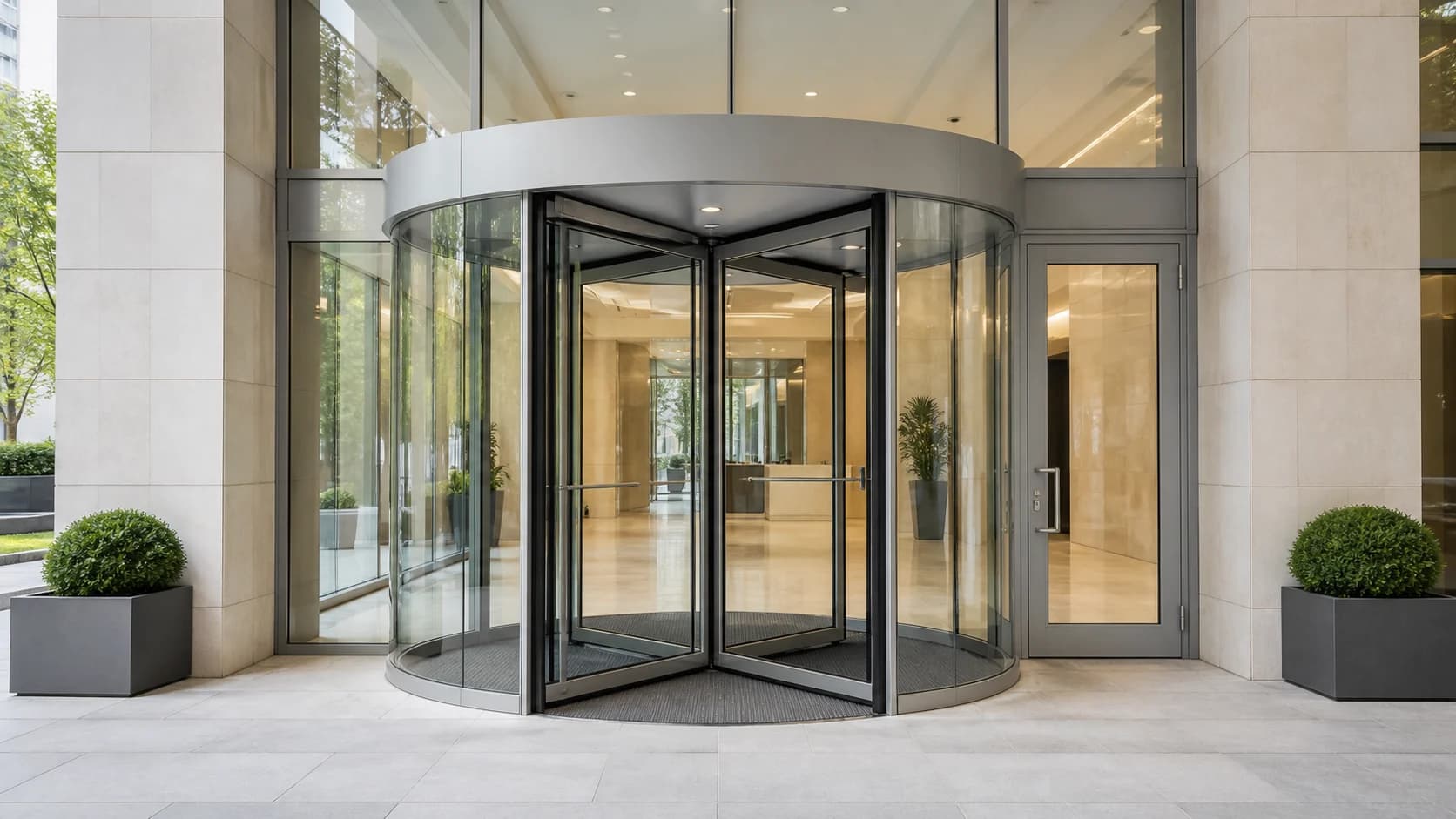
Automatic revolving door safety should be reviewed as a complete entrance system. The review starts with people and circulation, then connects the moving door geometry to monitored zones, controller responses, operating modes, external controls, accessibility and the responsibilities for installation and verification.
A sensor list alone does not complete that work. The project team needs to define which area each input covers, what condition it detects, how the selected controller should respond and how the finished sequence will be tested. The final arrangement remains specific to the selected door and applicable local requirements.
Review Framework
Automatic Revolving Door Safety Review Map
Use one connected sequence instead of reviewing isolated components. If a change is made to the traffic route, door geometry, sensor field or operating mode, trace its effect through the remaining steps.
People and Routes
Define who will use the entrance, how they approach it and whether luggage, trolleys, queuing or slower movement changes the expected passage pattern.
Moving and Monitored Areas
Map the approach, compartment entry, rotating wing path, wing edges, curved enclosure and any zone that the selected design needs to monitor.
Inputs and Modes
List activation devices, presence and safety inputs, emergency controls, access signals and every approved operating mode.
Controller Response
For each input, document the intended response, such as waiting, holding, slowing or stopping, subject to the selected controller and project requirements.
Verification
Confirm installation, commissioning, handover checks and the ongoing inspection responsibilities for the actual entrance.
For every reviewed area, ask: who uses it, what moves through it, what input monitors it, what response is expected and who verifies the result?
People Before Devices
Start With the Entrance and Expected Users
A revolving entrance is part of a circulation plan, not a machine placed in an empty opening. Begin with how the building expects people to arrive, pass through and leave the entrance. This context gives meaning to every later device and control decision.
Approach and circulation
Record approach directions, nearby cross traffic, queues and the space available before people enter a compartment. A clear plan view is more useful than a general statement that the lobby has high traffic.
Expected users and carried items
Consider visitors unfamiliar with the building, children, older users, people with limited mobility and users carrying luggage or pushing trolleys. These conditions can change walking speed, stopping behavior and route choice.
Alternative and controlled routes
Show any adjacent swing or sliding door, access-controlled direction, staff route and after-hours entrance. The project team should understand how each route is signed, released and kept available.
Automatic revolving door injuries are a serious search concern, but an article cannot diagnose a specific incident or prove a universal cause. Project review should focus on observable conditions: user routes, equipment state, selected settings, site records and the applicable investigation process.
Zone Mapping
Map the Moving and Monitored Areas
The rotating wings create changing compartments inside a fixed enclosure. A useful review follows a person through that geometry and identifies where activation, presence or safety-related monitoring is intended for the selected design.
Approach area
Review where an activation request should begin and which nearby movement should not start a cycle. Entrances beside corridors, reception desks or crossing pedestrian paths need especially clear field boundaries.
Compartment entry and passage
Follow the intended path from the opening into the moving compartment and through the opposite opening. Confirm where a person may pause, move slowly or change direction during passage.
Wing edges and enclosure interfaces
Identify the moving wing edges and their relationship to the fixed curved enclosure, floor and canopy. Device locations and fields must be reviewed against the selected geometry rather than assumed from a generic diagram.
Adjacent entrance and shared space
Check whether the alternative door, an access-control reader or another pedestrian route shares the same approach area. One route should not create an unreviewed conflict for another.
Keep the zone drawing tied to the selected entrance
A conceptual diagram can explain the review method, but it cannot prescribe sensor positions or field dimensions. Confirm the actual layout against the selected automatic revolving door operators, sensing devices, controller, installation instructions and project requirements.
Read Automatic Door Sensor Types ExplainedControl Sequence
Confirm the Controller Response
Detection becomes useful only when its input is coordinated with a defined response. Review the signal path from the field condition to the controller and then to the selected drive behavior. Avoid promising that every controller or mode reacts in the same way.
What produces the input?
Name the activation device, monitored zone, intentional control or building-system signal. A label such as safety sensor is not enough to define the event.
When is the input active?
Confirm whether the input applies before rotation, during movement, in low-speed access, in an access-controlled state or across more than one mode.
What response is intended?
Record the selected controller response and what must happen before normal movement resumes. The available response depends on the operator, controller, device arrangement and approved configuration.
How will the sequence be tested?
Assign who will verify each input and response after installation, after connected systems are integrated and during the handover process.
Write the sequence in plain language before approving the device schedule: when this condition is detected in this mode, the controller applies this response until this confirmed condition is met.
Modes and Controls
Review Every Operating Mode and External Control
Normal automatic rotation is only one system state. The review should include every mode the project intends to use and every connected signal that can change door behavior.
Normal automatic operation
Document approach activation, rotation behavior, monitored areas and the conditions for returning to the next operating state.
Low-speed or assisted access
Where the selected entrance includes a low-speed input or assisted mode, confirm how a user requests it, how the mode is indicated and how the sequence returns to normal operation.
Emergency stop and restart
Confirm the accessible position of emergency controls, the intended stop behavior and the authorized restart procedure. Do not treat an emergency stop as a substitute for the planned monitoring arrangement.
Manual, service and after-hours states
Review the modes supported by the selected controller, who may select them and how access-control or building-management signals affect the entrance in each state.
Interface ownership is a frequent coordination gap. Identify who supplies the emergency control, low-speed request, access reader, fire input, mode selector and cabling. Then name who connects and tests each signal with the entrance running in the relevant state.
Accessibility
Accessibility and the Adjacent Route
Accessibility requirements vary by jurisdiction and project. Review the whole entrance strategy early, including an adjacent route where required, its clear space, hardware, signage, activation method and availability during normal and controlled operation.
In the United States, the U.S. Access Board explains that revolving doors cannot be part of an accessible route. Where a revolving door is used at an accessible entrance, a compliant door must be provided next to it. This is a U.S. example, not a global rule, so the project team must confirm the requirements that apply at the building location.
U.S. Access Board guidanceThe adjacent route should also be part of the operational review. Confirm who can use it, whether access control releases it, how it behaves after hours and whether furniture, queuing or temporary displays could obstruct the approach.
Project Reference
Use Standards as Review Inputs, Not Marketing Claims
The applicable standard depends on the market, project and door arrangement. Current references can help the project team frame its review, but they do not by themselves prove that a proposed entrance, supplier or installation complies.
Examples of current regional references
ANSI/BHMA A156.27-2024 addresses power and manual operated revolving pedestrian doors in the United States. BSI lists BS EN 16005:2023+A1:2024 as the current British adoption covering powered pedestrian doors, including revolving doors. Confirm the required edition, national adoption and project-specific obligations with the responsible professional.
Conditional Checklist
Automatic Revolving Door Safety Review Checklist
Use this table to assign inputs and responsibilities. It is a coordination aid, not a universal device schedule or acceptance certificate.
| Review area | What to confirm | Project input | Responsibility to coordinate |
|---|---|---|---|
| Users and route | Approach directions, expected users, queuing, luggage or trolleys, slower movement and adjacent routes | Plan view, traffic description, accessibility strategy and site photographs | Architect, access consultant, operator and entrance supplier |
| Door geometry | Diameter or overall footprint, wing arrangement, enclosure, canopy, floor condition and adjacent openings | Coordinated plan, elevation, sections and verified site dimensions | Architect, contractor and entrance supplier |
| Monitored zones | Purpose and boundary of each approach, presence or safety-related area for the selected design | Zone map, device proposal, door layout and operating sequence | Entrance supplier, device supplier and commissioning party |
| Controller response | Expected response to each input in each approved operating mode, including the reset or resume condition | Controller schedule, interface list and sequence description | Entrance supplier, controls contractor and commissioning party |
| External controls | Emergency stop, low-speed request, access reader, fire or building-system interfaces and mode selector | Locations, signal type, cabling scope, authority and test method | Electrical, access-control, fire and entrance-system parties |
| Verification and handover | Installation checks, configured fields, complete sequences, user information, inspection plan and change control | Commissioning record, handover documents and named maintenance responsibility | Installer, commissioning party, facility team and owner |
Installation and Handover
Carry the Review Through Commissioning and Inspection
A coordinated drawing is not the final result. Site dimensions, floor levels, glazing, canopy interfaces, device positions and cabling must match the approved design. Connected systems need to be available when the complete sequence is commissioned.
During handover, record the configured modes, verified inputs and responses, authorized reset procedures and routine checks. The facility team should know who to contact if movement, noise, detection, an external signal or the adjacent route changes. Configuration changes should be controlled and reverified.
- Entrance plan, elevation and sections with verified dimensions
- Revolving door arrangement, intended capacity and approved operating modes
- Expected users, traffic directions, queuing and nearby cross traffic
- Adjacent accessible route and any access-controlled alternative entrance
- Proposed activation, monitored zones, emergency controls and low-speed inputs
- Access-control, fire, security and building-management interfaces
- Power, cabling, containment, installation and finish responsibilities
- Commissioning, handover, inspection and maintenance responsibilities
When requesting a quotation, include this information with the intended supply boundary. It helps distinguish equipment supply from installation, integration, commissioning and ongoing service responsibilities.
Common Questions
Frequently Asked Questions
What should an automatic revolving door safety review include?
It should include the users and circulation routes, door geometry, moving and monitored areas, activation and control inputs, the response expected in each operating mode, the adjacent accessible route, installation interfaces, commissioning and ongoing inspection responsibilities. The final review must be based on the selected entrance and applicable project requirements.
Can one sensor make an automatic revolving door safe?
A single device should not be assumed to cover every required area or function. Entrance safety depends on the coordinated sensor arrangement, controller logic, drive response, door geometry, external controls, installation and verification for the actual project.
What is the manual override for an automatic revolving door?
There is no universal manual override sequence. Manual or service operation depends on the selected operator and controller, the approved project configuration and the manufacturer's instructions. Authorized personnel should follow the documented procedure for that entrance.
What should users do if an automatic revolving door gets stuck?
Users should stop, follow visible site instructions and use the emergency control or adjacent route only as directed. Facility staff should isolate and assess the entrance under the site's authorized procedure. Users should not force the wings or attempt a repair.
How often should an automatic revolving door be inspected?
The inspection frequency should follow the applicable local requirements, selected equipment instructions, usage conditions and the facility's maintenance plan. The handover package should name the responsible party and define how faults or configuration changes are recorded and reviewed.
Final Review
Turn Safety Questions Into a Coordinated Entrance Plan
A practical safety review connects real users and routes to the selected door geometry, monitored zones, controller response and operating modes. It also assigns the people who will install, integrate, commission and inspect the finished entrance.
Send the entrance drawings, expected traffic, accessibility strategy, proposed controls and required supply scope. SEPPES can use those inputs to discuss the revolving entrance direction and identify the details that still need project-specific technical confirmation.